
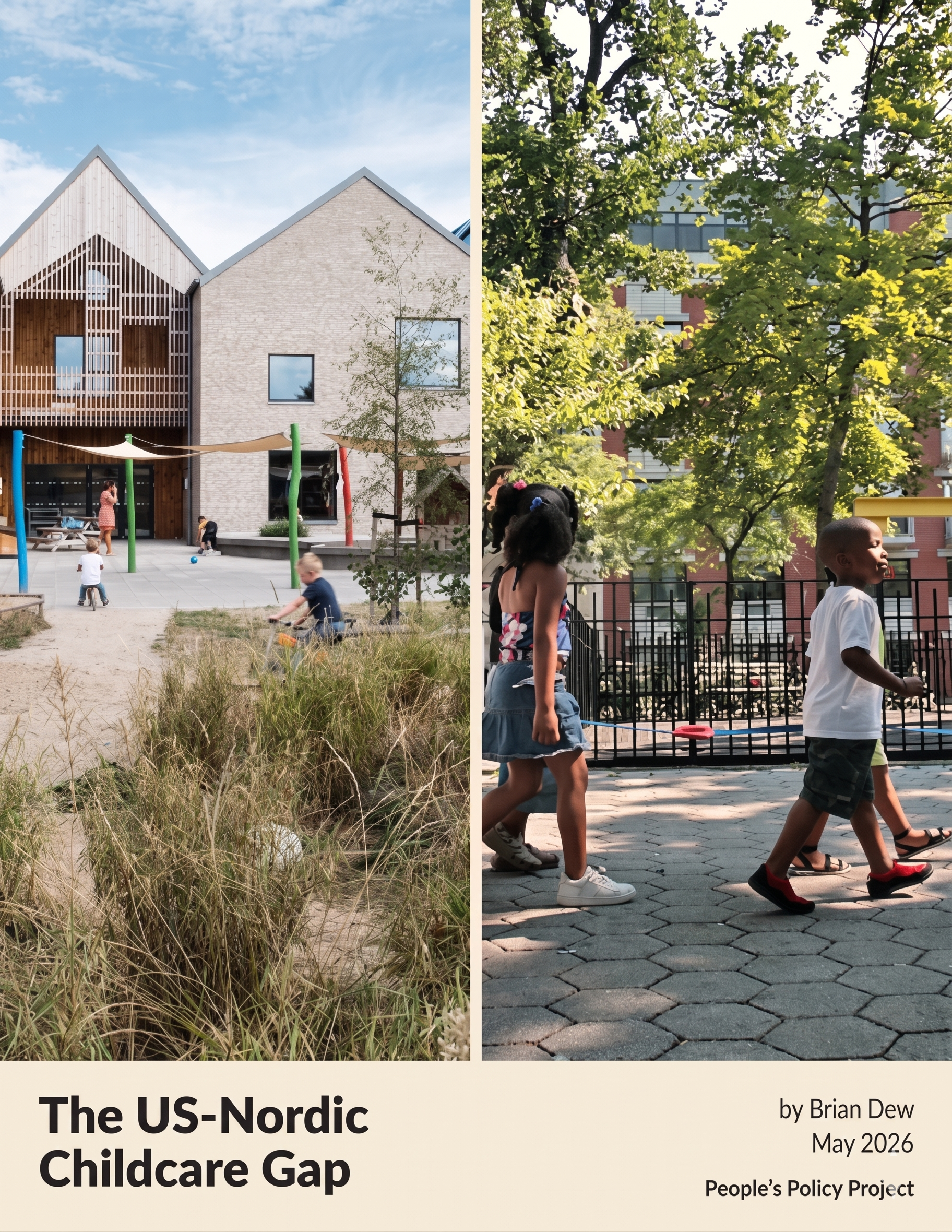
In April 2026, at an Easter White House lunch, President Trump said childcare should be devolved entirely to states. "We're fighting wars," he said. "We can't take care of daycare." Fifty-five years after Nixon vetoed the Comprehensive Child Development Act, the federal door to public childcare is still shut. In those same decades, the Nordic countries built high-quality public childcare systems that cover every child from age 1. The systems enroll most children, employ a stable workforce, and remain politically untouchable because every family depends on them.
The US has roughly the same financial resources per young child as the Nordic countries. In the Nordic countries, childcare is a public service. In the US, it is a private expense. Families, workers, employers, and children all get a worse deal than they would under a public system.
In the US, families pay fifteen thousand dollars per child per year for private childcare, or a parent leaves work. Employers draw from a labor pool structurally smaller than it needs to be. Childcare workers are paid less than nearly every other profession in the country; the system runs on childcare worker poverty. US child poverty runs four times the Nordic rate.
The market cannot fix this. Staffing a Nordic-style system requires professional wages, but in a private market those wages make care unaffordable for parents. The US has tried subsidies for the lowest-income families, but the main federal childcare subsidy reaches only about 14 percent of those eligible. Every country that solved this problem solved it the same way: the government became the primary funder, set professional wages, and charged families a fraction of the cost.
With the federal door shut, the path to public childcare in the US runs through the 50 states. None has solved it yet. Every state runs below the lowest Nordic country on funding, enrollment, and the childcare workforce. Vermont, the highest-funded US state, sits at less than half the lowest Nordic country. New York City and New Mexico are the closest to building a public system. Neither has yet matched Nordic scale.
Importantly, the lift of building a Nordic-style system is lighter today than in the past. The US economy has grown much faster than typical wages for lower-wage jobs, while birth rates have fallen. As a share of GDP, the same system would have cost about three times as much in the early 1970s.