

There has been a weird debate over the last few months about whether the United States is better off than Western Europe. The participants of this debate tend to operate under the shared premise that people in the United States are richer than people in Western Europe, and then quibble over whether that means it is better. But this shared premise is incorrect. Once you adjust typical economic aggregates for hours worked and inequality, Western Europe clearly pulls ahead of the United States.
Gross Domestic Product
Most of these debates start by comparing the GDP per capita of various countries. Below, I have graphed these figures using OECD data.
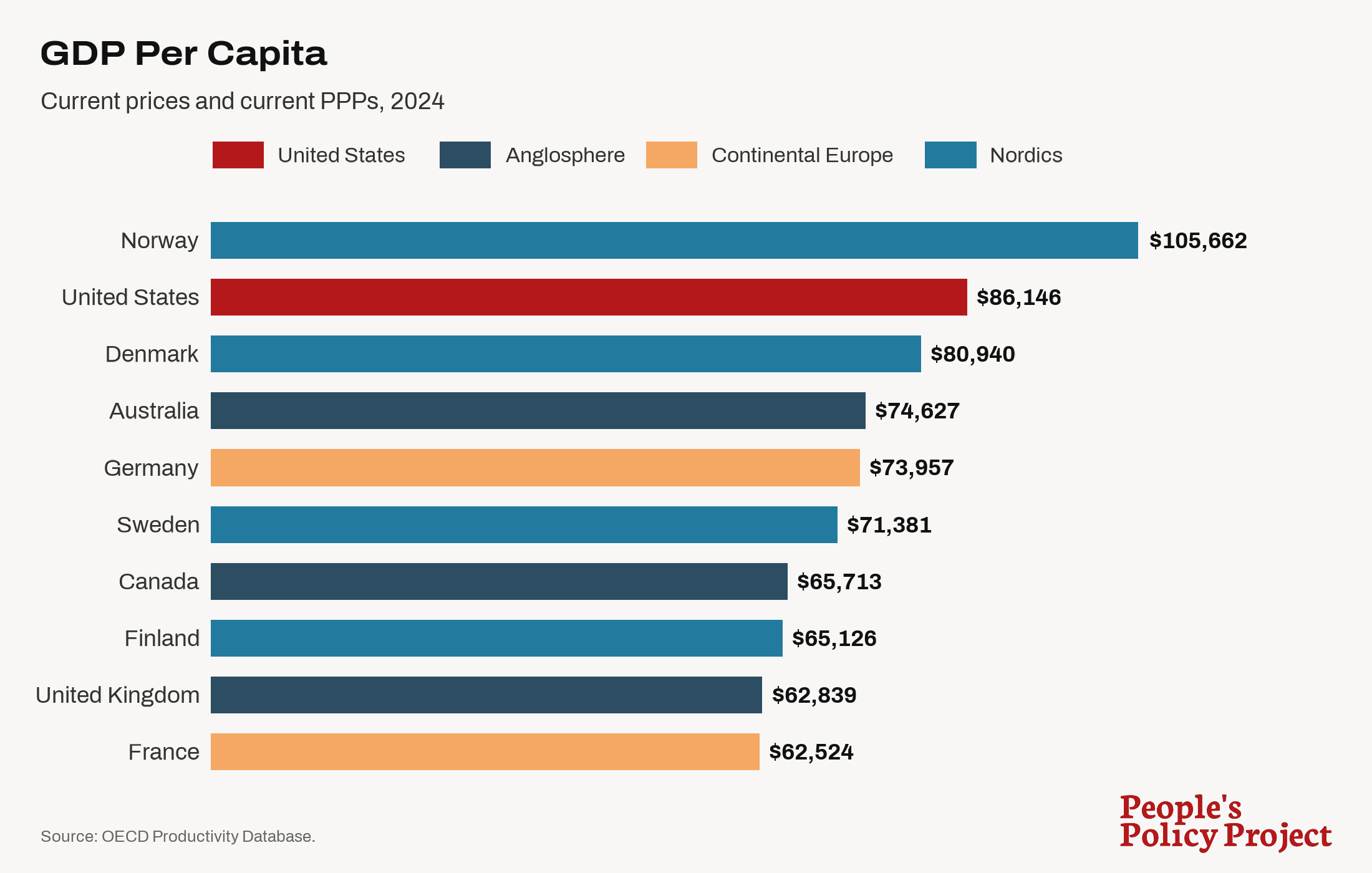
The obvious problem with this measure is that it does not account for how many hours of work each country has to put in to produce its GDP. This implicitly treats all time not spent working as having zero value. Childhood, student life, retirement, vacations, holidays, family time, and socializing are assumed to be worthless. Under such a metric, a country whose workers put in 80 hours a week to produce a certain amount of output is considered to be just as well-off as a country whose workers can produce the same output in half the time. This is nonsense.
To account for differences in leisure time across countries, you want to look at GDP per hour worked, which is a figure the OECD also provides.
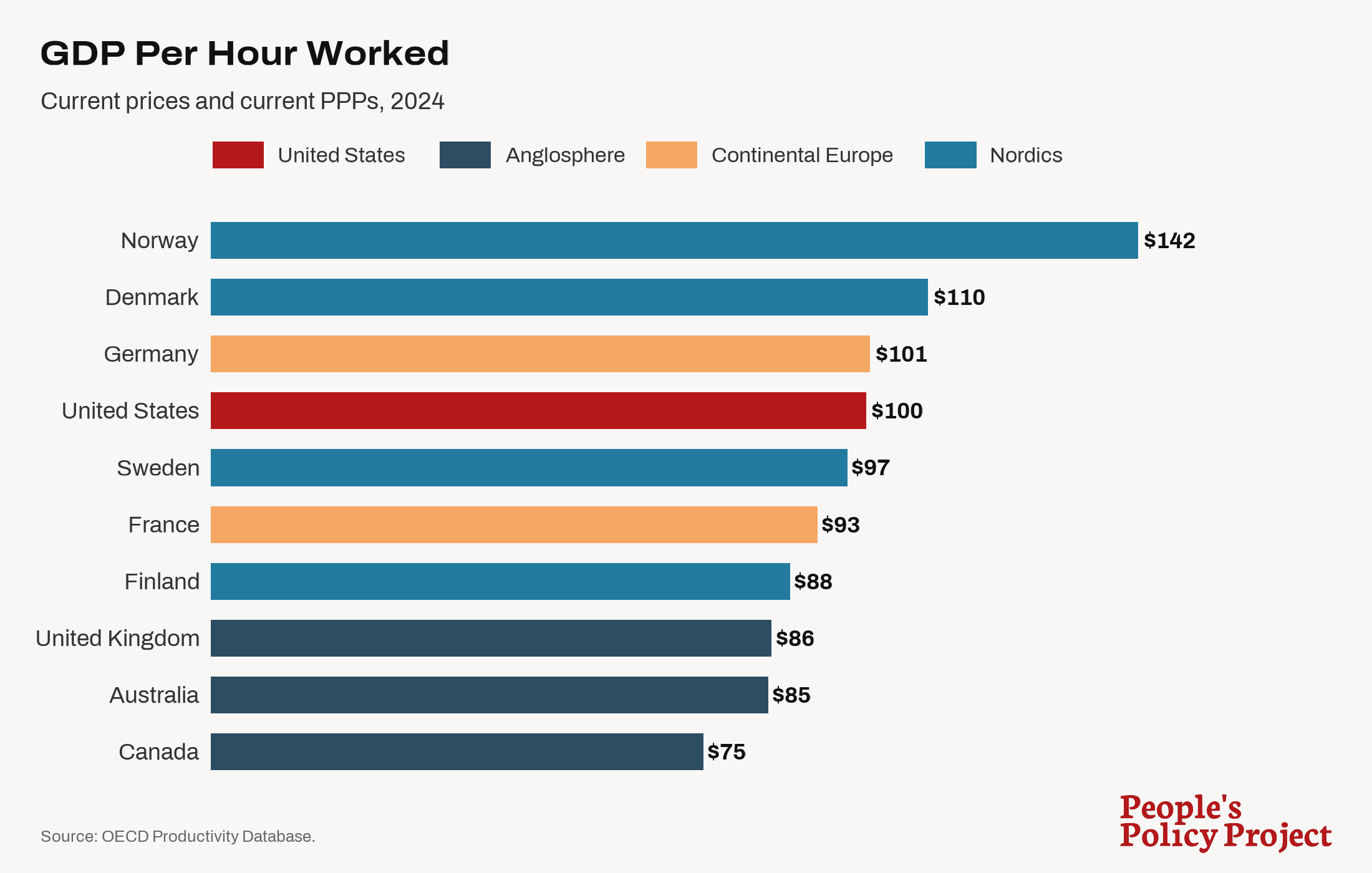
With this single adjustment, America no longer looks all that different from peer nations. Denmark and Germany have higher per-hour GDPs than the United States. Sweden is only 3 percent lower. France is only 7 percent lower.
The only way the US could fare much worse on GDP per hour worked than it does on GDP per capita is if these non-US countries work less than the US. There are two ways a country can work less than another: by having a lower employment rate or by giving its workers more time off.
In the below graph, we see that, with the exception of France, these other countries do not have lower employment rates than the US does.
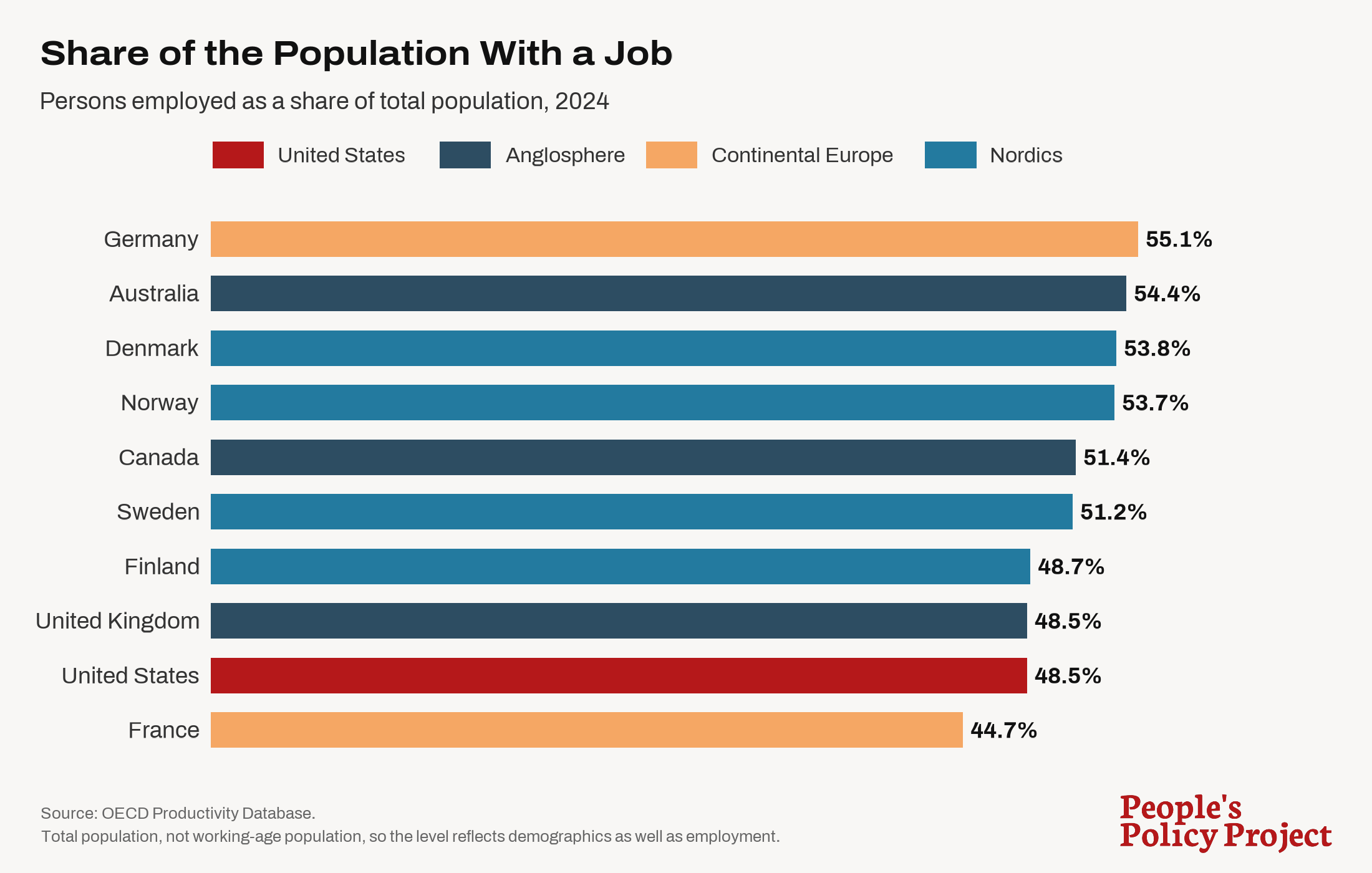
This means that their relatively better showing on the GDP per hour metric is driven entirely by giving workers more time off, generally in the form of holidays and vacations.
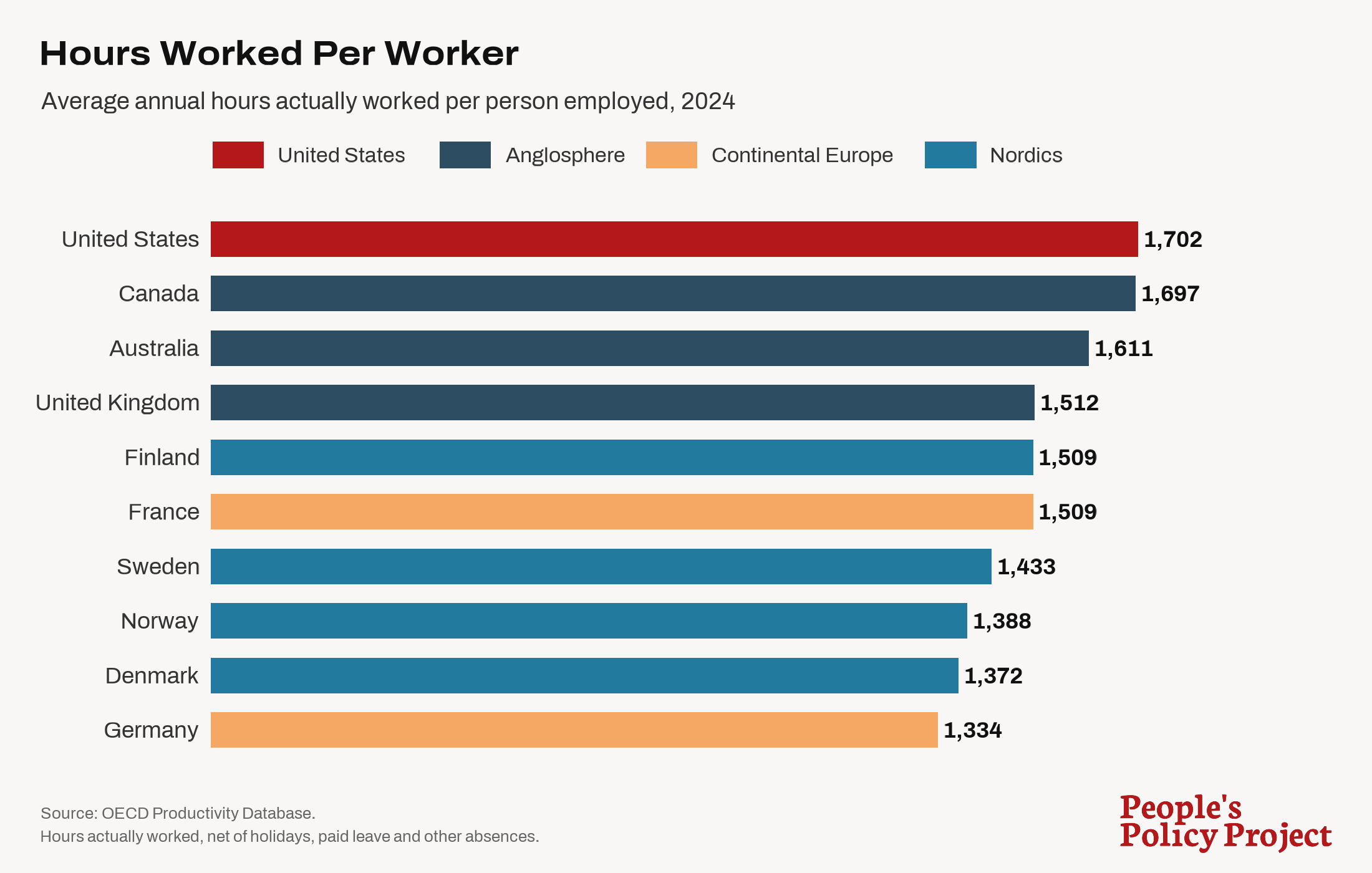
Germany is the most extreme case in the group, as it has a higher GDP per hour than America, the highest overall employment rate, and the lowest number of hours worked per worker. Germany is not poorer than the US. It has just chosen to cash out more of its productivity in the form of free time than the US has. The other Western European countries have made similar decisions.
Even with France, which is the only country that has a lower employment rate than the US, a little digging reveals that this is mostly driven by decisions it has made about retirement and student life.
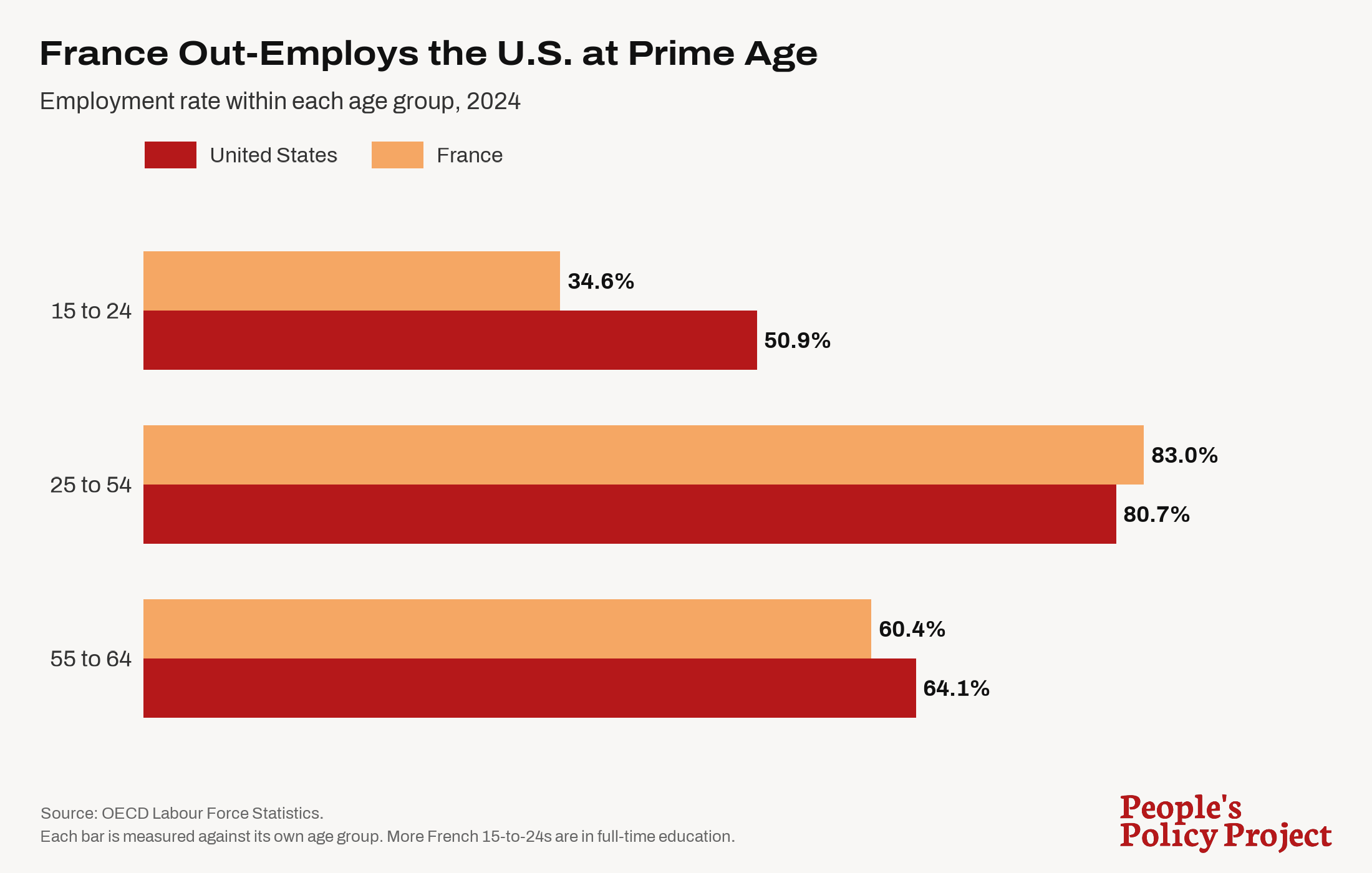
Among the prime-age (25-54) population, France actually employs a higher share of its population than the US does. It runs behind the US on overall employment only because the French retire earlier, more French young people are in college, and French college students are less likely to work than their American counterparts.
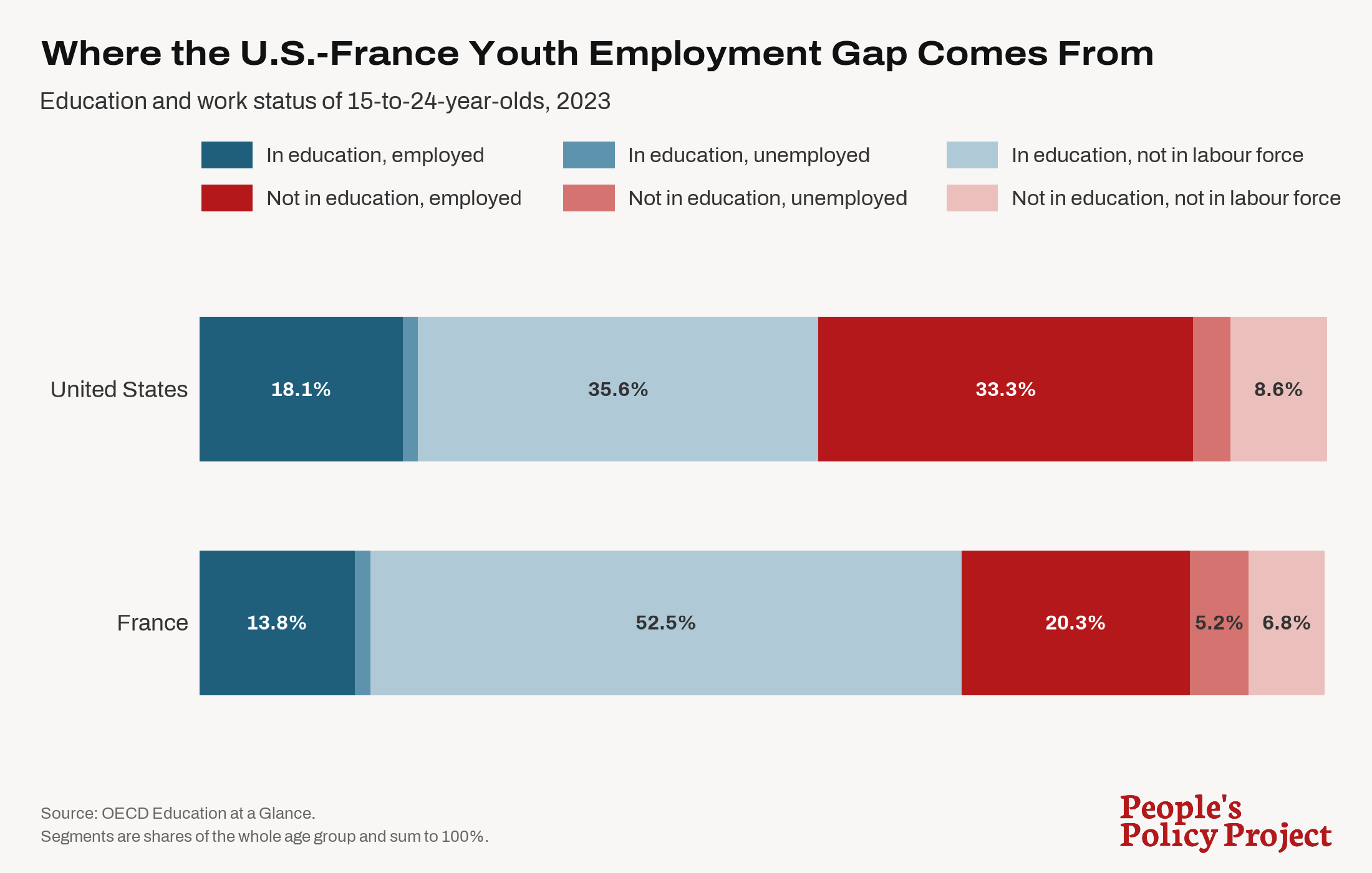
All societies, including the United States, make decisions about retirement timelines and the duration and nature of student life. France has merely decided to be more generous about those things than the US has, just as it has decided to be more generous about vacations and holidays. One can certainly argue that student life, retirement, and leisure are worthless or that France has overvalued them. But GDP per capita does not support that argument. It simply assumes it, by construction.
Inequality and Diminishing Marginal Utility
In addition to assuming that time away from work is worth zero dollars, the GDP per capita metric also assumes that every dollar of output has the same value regardless of how it is distributed. In reality, money has diminishing marginal utility, meaning that an extra dollar distributed to a millionaire is worth far less than an extra dollar distributed to a low-income or middle-income person. Thus, all else equal, a country with a more egalitarian distribution of income is richer — has more utility — than a country with a less egalitarian distribution.
On every conventional measure of disposable-income inequality, the US runs far behind peer nations.
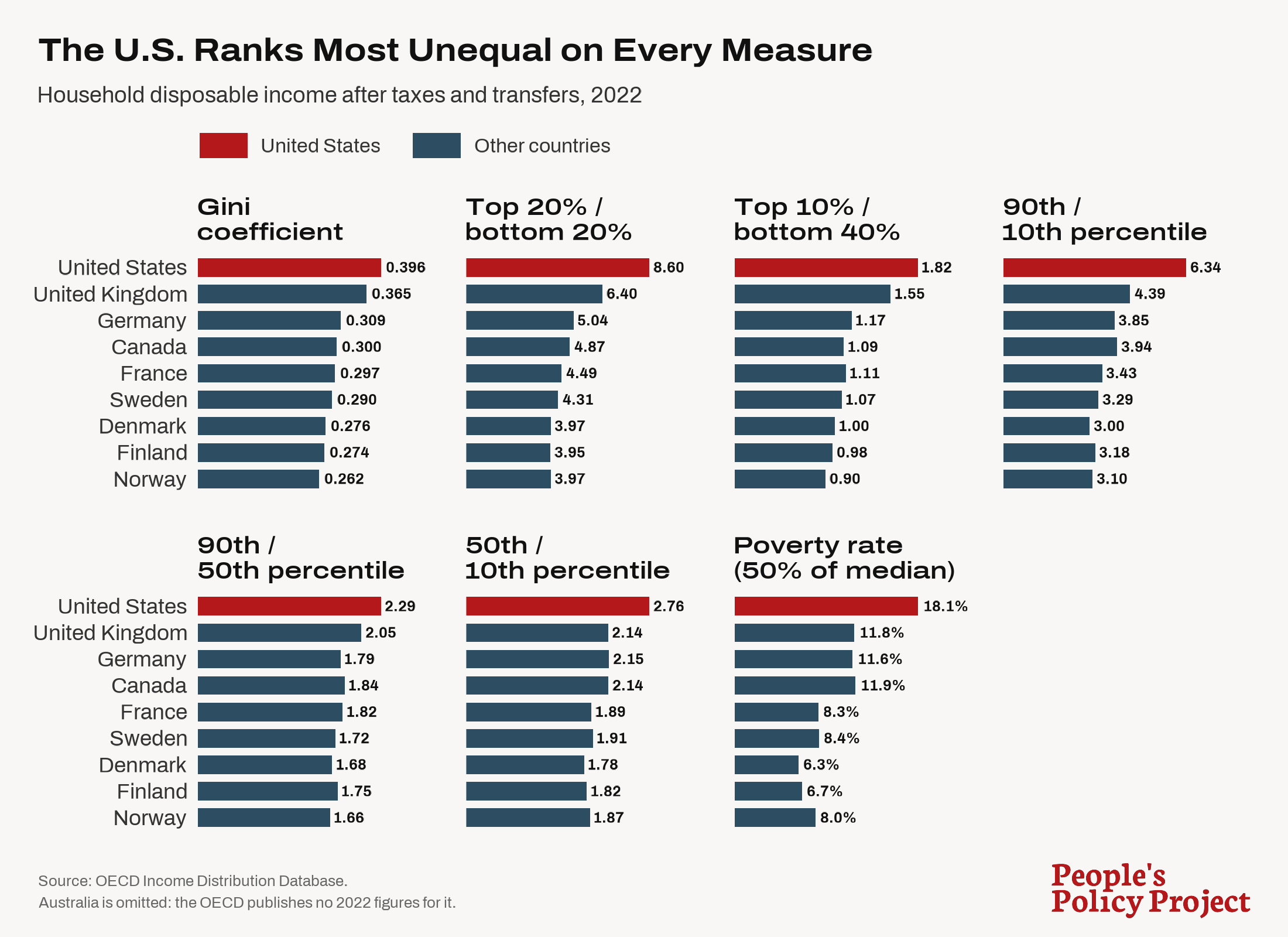
What small edge the US may still have after accounting for differences in hours worked is overwhelmed after factoring in the diminishing marginal utility of money.
Note that I am not doing anything particularly exotic in this piece. The fact that GDP is unable to capture the value of leisure time (or the value of non-market production), and the fact that this presents a problem when using it as a measure of affluence or general well-being, is totally uncontroversial in the economics world. The fact that money has diminishing marginal utility is also one of the foundational premises of marginalist mainstream economics. Other quality-of-life metrics like relative levels of safety and health can be used to argue in favor of Western European standards of living, but they are ultimately unnecessary. Conventional economic measurements alone get you there.